Blog
Where Are We, Actually?
Reflections on connected data, organizational resistance, and the real path to autonomous operations

Reflections on connected data, organizational resistance, and the real path to autonomous operations
A few weeks ago, I stood in front of a room of operations, quality, and digital leaders at Aspire and asked what I thought was a pretty honest question: where are we, actually?
Not where we want to be. Not where the conference agenda says we should aspire to. Where are we, for real, when you walk into your facilities and look at what’s been built?
The answer the room gave me was instructive — and, I think, worth sharing more broadly.
Most of the people in that room weren’t working off clipboards and paper binders anymore. But they also weren’t running lights-out facilities with self-correcting processes and machine-generated decisions. They were somewhere in between — digitally enabled, in many cases, but not yet digitally intelligent.
That’s my polite way of saying what’s real.
I find it more useful to name the middle than to skip over it. If we anchor the conversation in where organizations actually are — with all the gaps, the legacy systems, the manual workarounds — we can ask smarter questions about what needs to happen next. If we lead with the aspirational state, we tend to end up with roadmaps that nobody believes and initiatives that stall at the pilot stage.
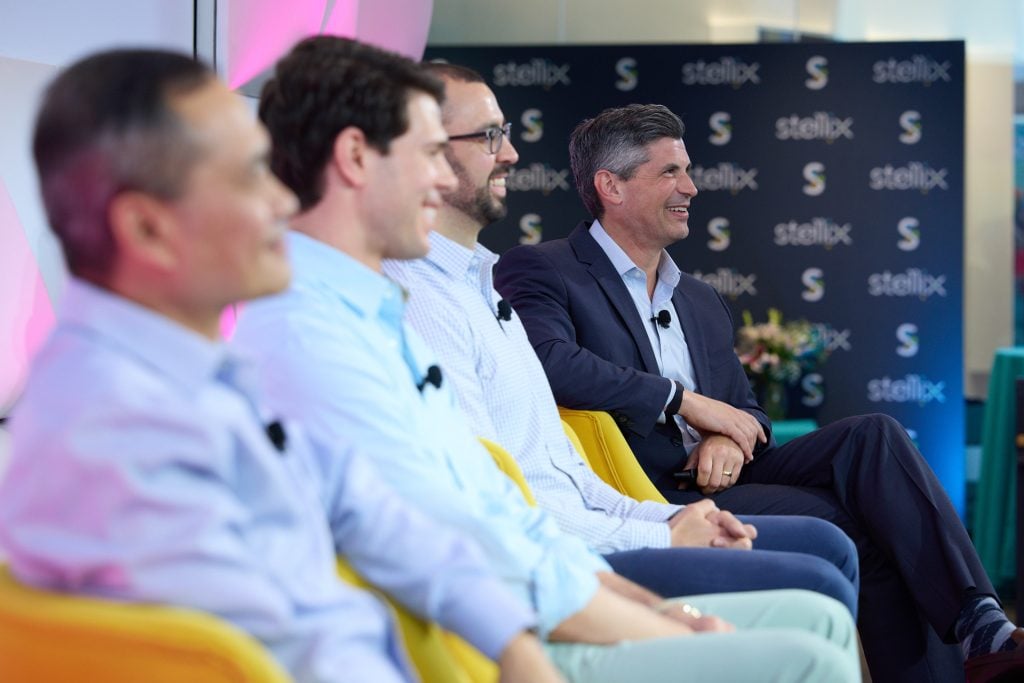
So, the panel I facilitated at Aspire wasn’t designed to sell a vision. It was designed to pressure-test one.
When we polled the audience on what was preventing progress toward autonomous operations, the top answer was a lack of connected data. Organizational resistance came close behind.
That’s not a coincidence. They’re related.
I keep coming back to a story I shared on stage. A colleague — someone who had spent real money building a suite of digital systems — walked into a room of engineers and asked a simple question: how do I get the information out of these systems and into a place where I can actually use it? And one by one, every person at the table gave him a version of the same answer. Not really. Not easily. Not without a custom build.
His frustration was palpable. I spent all this money. All this information is going into these systems. Why can’t I get it out?
It’s such a fundamental question. And the fact that it still doesn’t have a clean answer — in 2026, with everything we have available — says something important about where the work actually is.
The problem isn’t that data doesn’t exist. Data is being generated constantly — by instruments, by equipment, by quality systems, by MES and LIMS and SCADA. The problem is the last mile: getting that data from the systems that generate it into a form that can inform decisions on a broader scale. That connectivity gap is what makes everything downstream harder than it should be.
One of my panelists, Mark Maselli, Senior Director of Technical Operations at Tonix , described this from the perspective of a company that operates through a network of contract manufacturers. Information flows between those external sites and internal teams, but it arrives as PDFs. Technically digital. But not actually usable — not without someone manually extracting, reformatting, and re-entering it before it can feed a model or accelerate a commercialization timeline. The digital infrastructure exists. The intelligence layer doesn’t.
Michael Murphy, Engineering Director at Repligen, framed the same problem from the inside of a large manufacturing organization. His team had built good solutions at the site level — things that worked, things that solved local problems. But those solutions didn’t speak to each other. They were “local optimum.” Optimal at the facility, invisible at the enterprise. Getting from there to a coherent data strategy meant making hard decisions about what moves up and what stays local, and how to model it in a way that doesn’t require starting from scratch every time a new initiative comes along.
Connected data isn’t a visionary idea. It’s table stakes.
If I’m being honest — and that’s the only mode I know how to operate in — the connected data problem is actually the solvable one. It requires investment and discipline, but the technology exists. The harder barrier is the one we keep dancing around.
Alex Lee, who leads Global Automation & MES for the Americas region at Lonza, said it directly: it’s not a technology challenge. It’s a people and process challenge.
What that means in practice varies. Michael Murphy described a situation where everyone on his team wanted the same destination but was pursuing it with their own tools, their own timelines, and their own organizational momentum. It took a leadership reset along with a new approach to coordination to stop the duplication and get people paddling in the same direction. The technology didn’t change. The alignment did. And that made a measurable difference.
Mark described a different version of the same dynamic: in a world of small-batch, high-variability programs, bottom-up momentum is fragile. Projects can lose sponsorship. Leadership can change. Priorities can shift. Without visible, near-term proof points and consistent executive backing, the work can simply reset before it matures.
This came through in several ways across the discussion, but it landed hardest when we talked about business cases. The room told me that connected data was the top barrier, but business case wasn’t far behind — and the conversation around it was genuinely uncomfortable in a productive way.
Why is it still so hard to justify something we know works? Part of the answer is how companies evaluate savings. When the threshold for approval is hard savings — reduced headcount, direct cost removal — it filters out most of the real value that operational intelligence creates. Productivity is “soft.” Reduced cycle time is “soft.” Better decisions made faster by better-informed operators don’t show up cleanly in a spreadsheet. That’s a business model problem, not a technology problem. And it’s one that the operations and digital leaders in that room are navigating every single day.
I want to share something I mentioned at the end of the panel, because I think it’s the thing I’m most interested in right now.
A few months ago, I started experimenting with multi-agent systems — nothing exotic, just building small agent chains to handle tasks in sequence and see what they could do with minimal prompting. The output was remarkable. But that wasn’t the aha moment. That was just a cool toy.
The aha moment came later, when I watched what some of our colleagues were building with that same framework applied to OT environments.
I had always assumed that getting intelligence into manufacturing operations meant solving the point-to-point integration problem: this interface to that interface, this data pathway to that data pathway. Hard engineering, one connection at a time. But when you start thinking about it from an agent and AI perspective, you realize the question changes. You’re not wiring systems together anymore. You’re building intelligence between them.
That’s a different model. And if it holds — even partially — it suggests that some of the connectivity problems we’ve been treating as prerequisites might be more tractable than we thought.
I’m not ready to tell you that’s the answer. I’d rather have that conversation over a beer with the right people, which is something I offered the room and meant seriously. But it’s where my head is right now: less focused on how to solve the integration layer one piece at a time, and more focused on what it looks like when you start building connective intelligence across the environments you already have.
The panel didn’t end with a tidy conclusion because honest conversations about hard problems rarely do.
What it left me with was a clearer sense of where the real work is — and it’s not primarily in the technology. It’s in the unglamorous middle: connecting the data, standardizing enough to make that data usable across sites and systems, building the business cases that survive contact with finance, and sustaining the leadership alignment that keeps progress from resetting every time something changes.
Autonomy is the right horizon. I believe that. But I’ve spent enough time in plants and labs and supply chains to know that the path toward it runs through a lot of less glamorous work that we haven’t finished yet.
The more useful question, for most of the organizations we work with at Stellix, isn’t “are we ready for autonomy?” It’s “what’s the one next thing that reduces friction, surfaces better information, or lets our people make faster decisions?” Start there. Prove it. Use it to build the case for the next thing.
That’s not a ten-year argument. It’s a next quarter one. And in my experience, that’s what actually moves the conversation forward.
If any of this landed close to something you’re working through, I’d like to hear about it. The most useful thing that came out of Aspire was the conversation itself — not the polished framing, but the honest back-and-forth from people who are doing this work every day.
I’d like to see more of that, please.
Mike Cody leads the Digital Operations practice at Stellix, focused on helping life sciences and industrial organizations close the gap between data-generating systems and operational intelligence. He can be reached at linkedin.com or through Stellix.