Blog
Notes from Boston AI Week
3 Themes of AI-Enabled Transformation

3 Themes of AI-Enabled Transformation
Boston AI Week 2026 was a glorious, two-week stretch of immersion: eating, sleeping, and breathing AI, in community with some of the smartest, most innovative thinkers out there. I wanted to be everywhere at once.
Our team attended over a dozen events, from small dinners to speaker panels, listening to founders, researchers, operators, workforce leaders, investors, and business executives. That breadth of perspective offered a more complete view of the barriers organizations are facing—and the opportunities they are capitalizing on—as they move toward AI-enabled transformation.
Nearly every conversation I had ultimately turned to one of three themes: outcomes, operating discipline, and human capability.
My biggest takeaway from Boston AI Week was that AI capabilities should always be connected to business outcomes and solving a business problem. The right starting point is not, “Where can we use AI?” but rather, “Where is our biggest challenge as a business and which business outcomes matters most—and can we use AI to improve it?”
From there, organizations need to build the capabilities required to deliver on the most important outcomes: trusted data, integrated systems, clear governance, accountable owners, redesigned workflows, and people who are prepared to adopt and improve the new way of working. While the technology continues to impress, AI integration is primarily a leadership and operating model challenge, not a technology deployment one.
Operating discipline determines whether the potential of AI can be converted into value. While measuring platform usage and adoption may be appropriate in early stages, organizations need to move beyond how many pilots they launched and determine whether AI initiatives result in measurable improvements in areas such as decision-making, execution ability, delivery quality, and time to outcome, with those improvements sustained over time.
Operationalizing AI requires organizations to break apart and reconfigure traditional job descriptions, defining the discrete tasks, decisions, and workflows involved, determining which create the most value, and then discerning what to automate, what to augment, and what to keep distinctly human.
AI is fundamentally changing the unit of work, which presents an opportunity to shape performance around outcomes instead of activity. Embedding these changes into an organization requires leaning into the four factors in practical application of AI, as described by Stellix VP of Strategy and Technology, John Seffernick: knowledge capture, missing context, governance and security, and change management. Again and again, I heard colleagues deliberate the best approaches to incorporating these factors into their organizational infrastructure.
At the heart of every conversation about AI is its impact on people. It is increasingly obvious that as AI capabilities improve, human capabilities subsequently become more, not less, valuable. Knowledge is being democratized, but as information becomes more abundant and accessible, creativity, imagination, judgment, empathy, and resilience are the characteristics that continue to differentiate people and organizations. The people I connected with during Boston AI Week have nothing but respect for what people are already capable of, and hope for what technology and human capability can achieve together.
However, the tradeoffs of human capabilities were also part of the discussions. Perhaps the toughest challenge for me to confront was the cognitive load that comes with continuous iteration and a rapid pace of change. Speed and complexity can be absorbed in bursts, but the new paradigm of an AI-fueled future is one of quick and constant change. Which raises an important question for leaders: How do we build the capacity to keep learning and improving, absorbing change indefinitely, without creating cognitive exhaustion?
Slowing down isn’t a viable option, not with so much to learn and discover. (I’ve had to accept the horrifying fact that you can’t keep up with AI progress through books; they are outdated by the time you read them.) A better path is focus, first and foremost by bringing absolute clarity to the outcomes we are pursuing. Then, designing better rhythms for learning, experimentation, recovery, prioritization, and decision-making. Not every new capability can be treated as urgent, and we must accept tradeoffs if we want to build momentum instead of spinning our wheels.
Across Boston AI Week, the demonstrations of physical AI grabbed my attention most. Physical AI is an embodiment of these three themes—outcome-driven approach, operational discipline, and human capabilities and limitations—and has the ability to perceive, reason, and act in the physical environments where work is done. The implications are enormous for life sciences, healthcare, industrial, and other complex operating environments, provided the capabilities drive toward the outcomes that matter: safer operations, more reliable production, better quality, less downtime, faster learning, and improved human-machine collaboration.
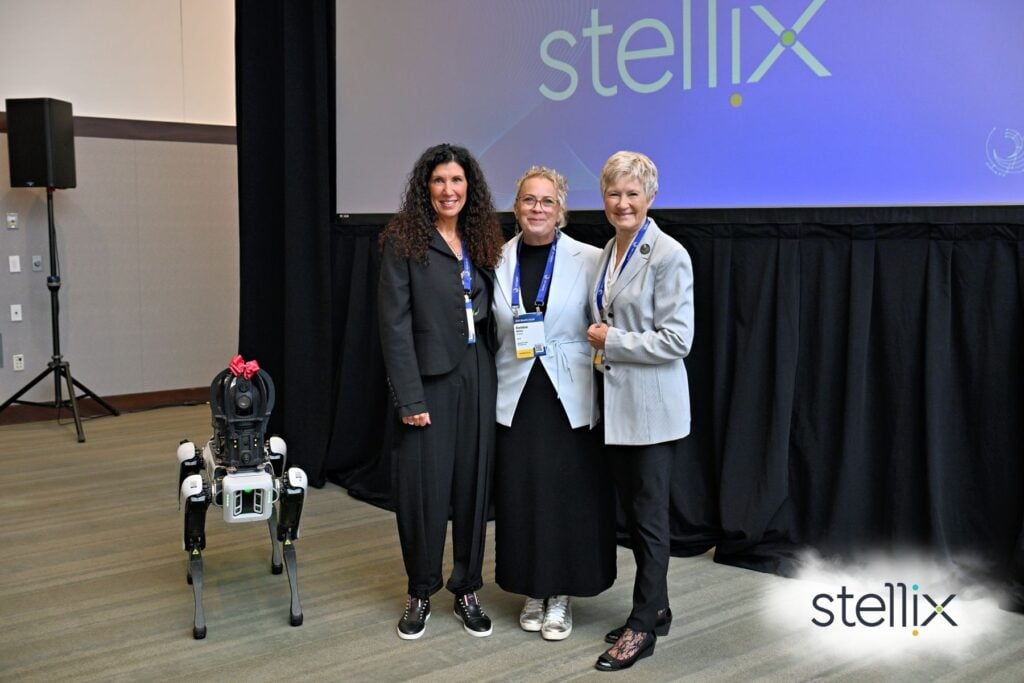
Stella, our quadruped robot dog, accompanied me to several events as our own demonstration of physical AI. After dozens of customer site visits, we have identified numerous practical applications for Stella in manufacturing facilities. The convergence of AI with devices, robotics, sensors, and operational technology holds great promise, as long as we can also provide the trusted data, safety, validation, cybersecurity, and IT/OT integration required.

That is where the conversation becomes particularly relevant to Stellix: helping organizations move emerging technology into real operations, responsibly and measurably. Nobody needs more AI theater or another spin on the hype cycle. What’s needed most are tangible solutions to complex problems.
Every conversation at Boston AI Week will make our team better. Each insight and opinion helps us improve our models, playbooks, and client offerings so they are grounded in the realities of implementation and not just excitement about the technology. I can think of no better community to learn from than this one, a group of learners, leaders, optimists, and builders. A community that is unafraid of its own ambition but humble enough to admit there is no finished playbook for what they set out to achieve. Everything is, always, a work in progress.
The future of AI will be shaped by the organizations that can apply this powerful technology to transformational initiatives that create durable business value. We can only succeed through that combination of ambition and humility: sharing what works, acknowledging our failures, challenging assumptions, and committing every day to translating possibility into progress.