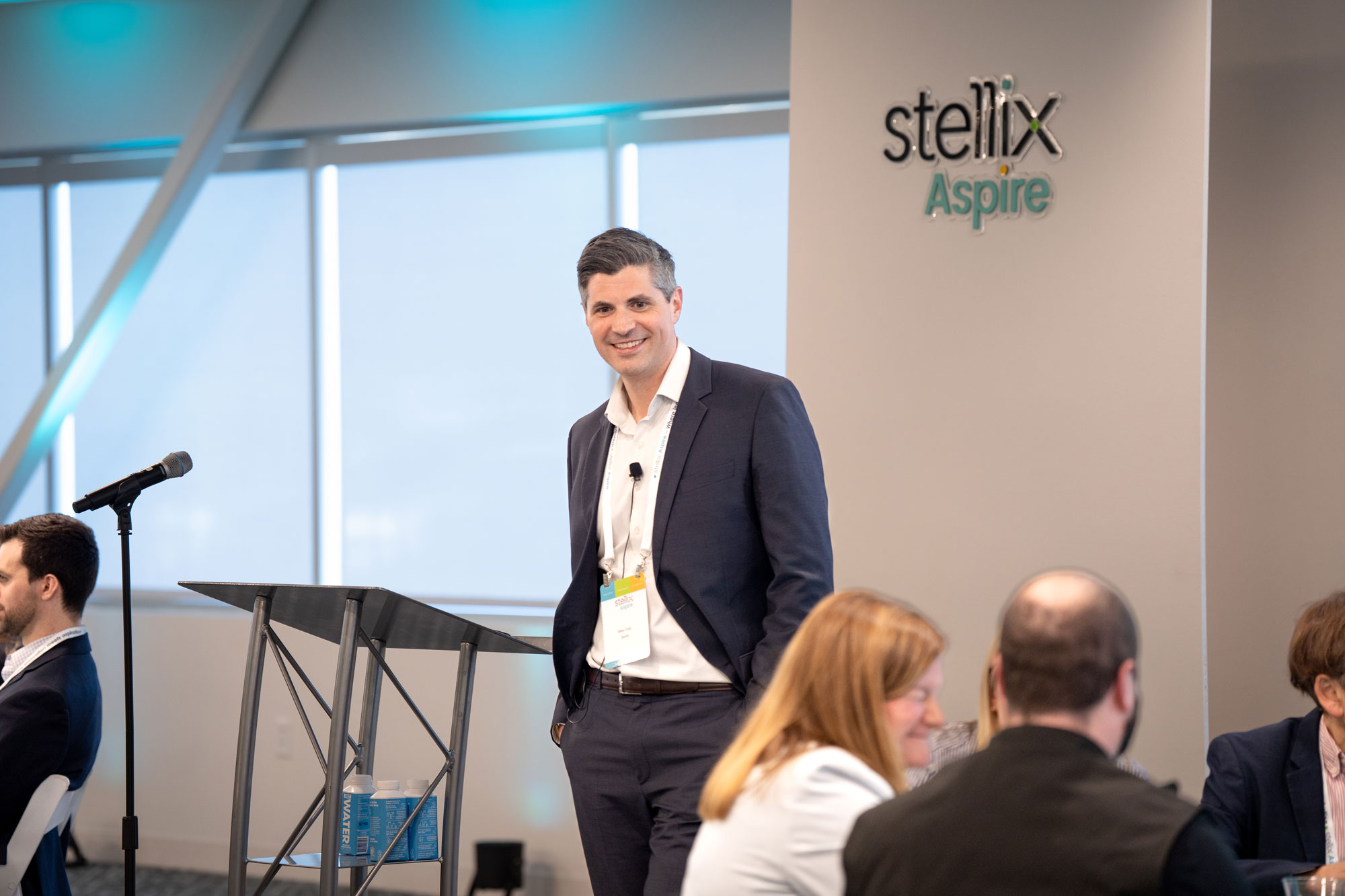
At Stellix’s first Aspire gathering of 2026, I led a breakout on a topic that sits at the center of my work: how AI is actually showing up in process operations today.
I come at this as a practitioner. My world is how physical things work in plants, labs, utilities, and supply chains—and how digital and AI systems either help or get in the way. From that vantage point, I see both sides of the current AI moment in life sciences: the excitement, and the very real friction in day-to-day operations.
In this post, I’ll recap three themes from the session:
- Why we started with an honest baseline and benchmarking conversation
- What’s really working with AI in operations right now
- The barriers the room surfaced—and why community is how we move past them
1. “Are you where you want to be?” — starting with an honest baseline
I opened the session with a deliberately leading question:
Are you where you want to be in your AI strategy?
If you only listened to conference stages and vendor keynotes, you might assume the answer should be “yes.” Autonomous plants, auto-closed deviations, real-time batch release, adaptive scheduling across a global network—it can sound like everyone else is already there.
In our Aspire room, the reality was different.
Most leaders around the tables shared some version of the same truth: we’re still early. Teams are experimenting. There are promising pilots. But as an industry, we’re a long way from AI being a scaled, reliable layer across manufacturing, quality, and supply.
The more uncomfortable reality is that very few people know how they actually benchmark. Sitting with peers, you don’t know if you’re ahead, behind, or about average. You see pockets of excellence and glossy case studies, but not a clear sense of “normal.”
So before we talked about use cases, we aligned on language. I brought in a simple horizon framework, adapted from McKinsey, to give the room a common mental model:
- Entry-level: using large language models (LLMs) and related tools to assist humans—summarizing, drafting, and accelerating existing work.
- Novel: orchestrating processes across systems, sites, or functions, where AI coordinates workflows that used to be stitched together manually.
- Frontier: adaptive plants, real-time batch release, network-level optimization across a manufacturing footprint.
Most of the examples we heard landed squarely in the first two horizons. That’s not a problem to be embarrassed about; it’s a timestamp of where life sciences operations actually are in 2026.
With that baseline set, we turned to the question that matters most in this moment: what’s already working?
2. What’s working now: real wins from real operations
Rather than present my own list, we used facilitated table discussions to crowdsource wins from across the room. When we pulled those threads together, four themes stood out.
Machine learning is more accessible than ever
One comment captured a shift many of us are feeling:
“You don’t have to be a technologist to really get value out of the tool sets that are available.”
Machine learning itself isn’t new to life sciences. What is new is how usable today’s tools have become for people who live in the process, not in the code:
- Process SMEs and scientists can explore models without going through a long data-science queue.
- Operators and engineers can use ML-driven analytics to spot trends and relationships that would have been invisible a few years ago.
- Pattern detection and anomaly spotting are moving closer to the front line.
This is quietly changing conversations in tech ops. You no longer need a room full of specialists to get value from ML.
LLMs are becoming part of daily work
We also heard multiple examples of widespread LLM use across clinical development and internal operations. These are not “run the plant for me” copilots. They’re focused assistants that make existing work faster and less painful:
- Drafting and reviewing technical documentation
- Summarizing deviations, investigations, and meeting notes
- Supporting clinical teams with protocol summaries and data extraction
The impact is simple but powerful: compressing hours of knowledge work into minutes, in ways that fit within controlled environments.
Scientists as coders—with help from AI
One table shared a story that got a lot of nods: scientists using AI to write control loop code in Python.
Instead of throwing requirements over the wall to a separate automation team, they’re working with AI-assisted coding tools to capture the logic they understand best—the behavior of the process—and translate it into code. That doesn’t replace the need for rigorous engineering and validation, but it dramatically shortens the loop between “I know what needs to happen” and “the system is doing it.”
Seeing what humans would never catch
Finally, we heard several examples of AI doing what it does best: digesting large datasets and spotting anomalies humans would never see.
One that resonated was chromatography:
Historically, you overlay chromatograms, compare them to a gold standard, and as long as everything falls within your bands, you move on. With AI-driven pattern recognition, teams are now able to:
- Look much deeper into those elution profiles
- Identify subtle anomalies and emerging patterns that were previously invisible
- Intervene earlier, before those signals turn into deviations or failed lots
None of these use cases are moonshots. They’re grounded, operations-centric wins. And they’re exactly the kind of evidence leaders need to justify moving from curiosity about AI to sustained investment.
3. The barriers in our way—and why community is how we move past them
The moment we finished celebrating what’s working, the conversation turned—naturally—to what isn’t.
When we asked each table to surface their top barriers, the convergence across organizations was striking.
Data readiness as the unavoidable first step
The first question many teams ask themselves is:
What dataset am I using? How accessible is it? Can I continuously grow it?
As one participant put it, “it’s all around that readiness of data because it’s fundamental to how you start feeding and building your models.”
Across companies, the story is familiar:
- Critical data is still trapped in paper batch records, PDFs, and disconnected systems.
- Attempts to centralize reveal just how inconsistent “simple” fields can be across sites and partners.
- Even when an AI or analytics engine exists, getting high-quality data into it at the right cadence is a significant program of work.
Until this foundation is in place, every other conversation is constrained.
Regulatory uncertainty in GMP decision-making
On the GMP side, regulatory expectations for AI are still evolving, and that ambiguity slows teams down.
Questions we heard repeatedly:
- Can we use AI to generate or complete an electronic batch record?
- If an AI system recommends an action during execution, what exactly is considered “validated”?
- How do we prove—credibly—that a model behaves reliably enough to influence release, deviation triage, or process adjustments?
In many cases, the technology is ahead of the comfort level of quality organizations and regulators. Caution is warranted, but it also means some of the most compelling use cases are stuck in limbo.
The security paradox
Another theme was what I think of as the security paradox.
On paper, companies are doing the right thing: tightening access to AI tools and data to protect IP and patient privacy. In practice, when controls become too restrictive, something predictable happens: people work around them.
We heard about:
- Shadow tools built on laptops because official platforms were inaccessible or too slow
- Data copied into unsanctioned environments “just to get the work done”
- Fragmented user experiences because the infrastructure hasn’t caught up with the ambition
The result is exactly what CISOs and QA leaders fear: higher actual risk, despite stricter policies.
ROI, scale, and “spaghetti strategy”
Even when a use case shows promise, leaders are still wrestling with two linked questions:
- What’s the real ROI? It’s one thing to say a tool makes work “easier.” It’s another to tie it to throughput, yield, right-first-time, or time-to-market in a way that stands up in a budget review.
- How do we scale it cost-effectively? Pilots are often bespoke. Scaling across sites, products, or modalities introduces integration, validation, and change-management costs that can dwarf the initial win.
Several people described what one attendee called a “spaghetti strategy”: throwing AI ideas at the wall to see what sticks, rather than pursuing a coherent portfolio tied to business drivers and operating model.
Culture, governance, and leadership expectations
Underneath all of this sits the human and organizational layer:
- Cultural inertia and fear of new ways of working
- Underdeveloped AI governance—unclear ownership, standards, and lifecycle for models
- Leadership mandates without frameworks—“go do AI” without a clear roadmap, enablement model, or time carved out for people to learn
These are not side issues. In regulated operations, they often matter more than the technical architecture.
Looking backward to move forward—and the role of community
When we talk about horizons and frontier use cases, it’s tempting to try to predict what plants will look like five or ten years from now. The truth is, that’s hard to do from where we sit.
I find it more useful to look backward at how “risky” ideas become standard.
In the session, I shared a story from 2012. I was working with an organization going through a major upgrade. At the time, the quality organization refused to allow the team to virtualize their servers. Virtualization, they argued, was “too much of a risk.” They wanted separate physical machines so they could be sure where the data lived.
Fast forward four years. In 2016, Veeva launched the first GMP-validated SaaS platform for quality management. Today, that same kind of data is sitting in cloud platforms like Azure and AWS, moving around all the time. SaaS is not just accepted; it’s the default. Many of us are exhausted by the number of SaaS tools we log into every day.
What felt unacceptable in 2012 is now boring infrastructure.
I believe we’re in a similar moment with AI in life sciences operations. The questions you’re wrestling with now—about data readiness, validation, and governance—will feel very different a decade from today. The challenge is to move forward responsibly, without waiting for the future to arrive fully defined.
That’s where community comes in.
Aspire is not a one-off event. It’s a mechanism for collective learning and progress. By bringing quality leaders, digital operations teams, manufacturing heads, and partners into the same room, we can:
- Benchmark honestly against peers, not just against slideware
- Share what’s actually working and what isn’t, in enough detail to matter
- Co-create patterns, governance models, and reference use cases the whole industry can build on
Where Stellix fits in
At Stellix, our role in that community is to be a credible, grounded partner—one that meets you where you really are, not where the hype cycle says you should be.
We focus on operational foresight and AI-driven solutions that are anchored in how your plants, labs, and supply chains actually run today. That means:
- Starting from process reality, not abstract use-case catalogs
- Tackling data readiness in a way that supports both today’s reporting and tomorrow’s models
- Designing AI into GMP environments with validation, compliance, and culture in mind from day one
If you’re grappling with where your AI program sits on the horizon, how to move from isolated pilots to scaled operations, or how to navigate the regulatory and cultural barriers we discussed at Aspire, I’d welcome the chance to continue the conversation.
Reach out to the Stellix team, and let’s explore what “AI in the present moment” could look like in your operations.