Blog
The future of intelligent manufacturing starts with responsible AI deployment
Aspire April 2026 Recap: Deploying AI Responsibly in Regulated Environments

Aspire April 2026 Recap: Deploying AI Responsibly in Regulated Environments
On April 9, we gathered at Stellix for our first Aspire event of 2026, bringing together life sciences leaders across R&D, digital, manufacturing, regulatory, and operations to explore responsible, scalable AI in regulated environments. The team did an incredible job building an agenda around a single, urgent question:
How do we move AI from experimentation to real operational impact—particularly in environments as regulated and mission-critical as life sciences?
Not long ago, discussions about AI in life sciences focused on its potential, which, as we all know, has since become clear. Now, as organizations aim to maximize that potential, the pressure is on to get it right. The following themes relevant to deploying AI responsibly emerged.
AI implementation is as much a human transformation as a technical one. Success depends on aligning teams and processes, establishing effective governance, and prioritizing change management. It’s not enough to deploy new tools—people must see their value and be equipped to adopt them.
Initiating AI pilot projects in isolated silos delivers only incremental gains. To achieve meaningful business outcomes, organizations must commit to system-level change—redesigning human capital systems and business workflows to maximize AI’s full value.
AI is dramatically accelerating speed-to-value, shrinking the window between concept and execution. It’s not a bad problem to have, but it does mean approaching projects differently. Whether designing new workflows or new manufacturing facilities, cross-functional collaboration must occur early in the build phase. Otherwise, projects may reach completion before all key voices have had a chance to influence the outcome.
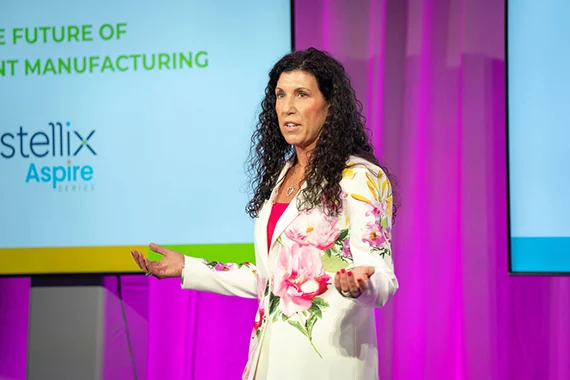
Our keynote speaker, Noelle Russell, brought a practical, experience-driven approach to scaling AI in manufacturing. A celebrated TEDx speaker and AI leader, Noelle has built robust production systems for companies like Amazon and Microsoft.
Noelle introduced the “baby tiger” metaphor. The idea is that we’re surrounded by “baby tiger” AI models—small, impressive tools that seem friendly enough in the sandbox. The challenge isn’t deciding to adopt them; it’s navigating what follows. When you bring a baby tiger into your organization, you must ask three critical questions from day one:
Noelle’s message was clear: In regulated, mission-critical fields, treating AI experiments lightly can have serious consequences. At Stellix, we counter this risk by approaching AI initiatives with operational foresight, planning for future needs across plants, regions, and partners.
Noelle’s most resonant anecdote was also the most deeply human. During a project, she observed nurses interacting during shift changes—a process that took nearly 90 minutes. She built an app to streamline the process, reducing it to ten minutes. But when she introduced the app, the pushback was immediate. Although the app captured data perfectly (and quickly), the nurses had lost their only real opportunity to connect with and support each other during their shift transitions.
The lesson: Optimizing solely for efficiency can undermine critical human elements. Responsible AI deployment must account for what the people who will be using the tools truly need.
I recently read that the last real competitive advantage in biologics isn’t the molecule—it’s clock speed. Companies that move from data to product to approval to reliable supply the fastest will win.
Many life sciences leaders have yet to fully grasp just how much AI accelerates the generation of novel biologics and the identification of new indications for existing therapies. Discovery is no longer a bottleneck. Today’s challenge is prioritizing and scaling the right molecules, and ensuring downstream processes—regulatory, manufacturing, quality—can keep pace with discovery.
Most organizations are unprepared for this reality. Fragmented systems, manual handoffs, and outdated data slow them down. But layering AI on top of legacy systems won’t solve these structural issues. The solution is rebuilding the systems to be AI-native.
If AI delivered 10 credible drug candidates tomorrow, could your organization advance them, or would your current infrastructure hold you back?
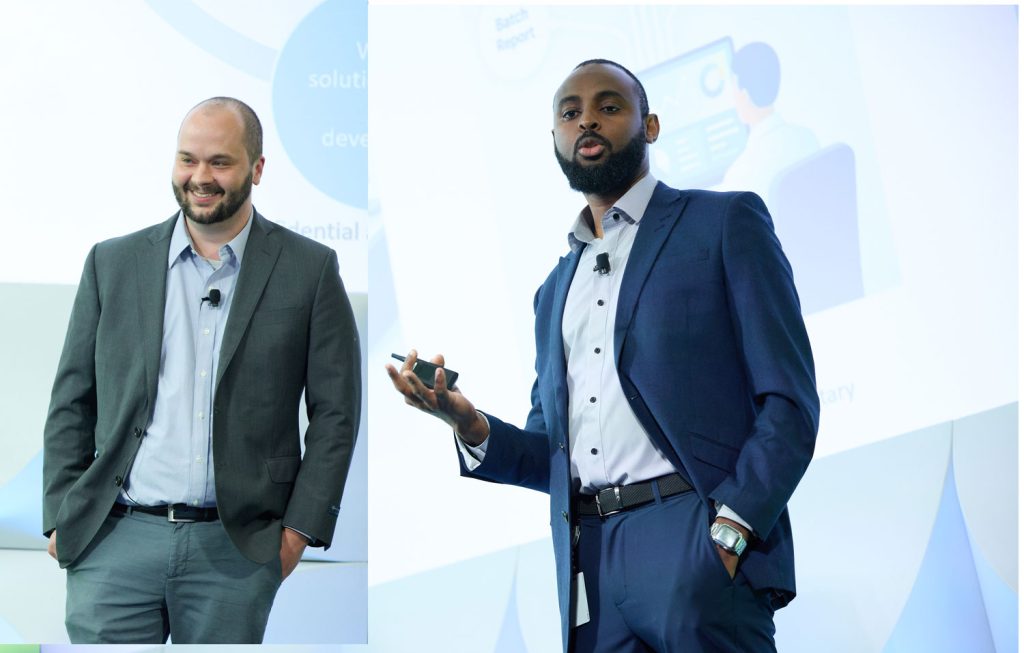
At Aspire, Mike Cody and Jordan Croteau addressed this challenge head-on. Mike urged organizations to become AI-ready, integrating AI holistically across strategy, operations, and culture, rather than treating it as an add-on.
Jordan pushed the conversation further, envisioning a move from “human in the loop,” where humans provide authorization or approval before AI can act, to “human on the loop,” where AI operates autonomously, and humans interfere only when necessary. He described a future built around an AI mesh, a digital fabric connecting multiple AI agents, tools, and data sources into one centralized system.
While this vision may be a few years away, the technologies (agentic AI, machine learning) are already here. The next step is integrating them into a seamless, AI-native system.
As I looked around the room during Aspire, I saw something that continues to give me hope: leaders from quality, digital, manufacturing, and site operations breaking down silos to come together and tackle the industry’s toughest questions.
The path forward is demanding. But with an approach that balances ambition with responsibility and prioritizes holistic, cross-functional outcomes, AI will accelerate speed to market while honoring the needs of the people who make life-saving therapies possible. That is the future of intelligent manufacturing, and I look forward to more conversations with our community about making that future a reality.