Blog
Bridging Organizational Gaps Will Deliver Results
How aligning people, processes, and technology around shared outcomes can accelerate performance in life sciences

How aligning people, processes, and technology around shared outcomes can accelerate performance in life sciences
Life Scienes organizations are inherently cross-functional. Quality, operations, engineering, and IT/OT are all required to deliver safe product—yet each function is optimized for different outcomes, measured on different KPIs, and governed by different decision rights. The predictable result is friction at the handoffs, even when every team is high-performing and fully committed to the mission.
This dynamic is not unique to life sciences. McKinsey research finds that ~70% of transformations fail, with contributing factors including insufficient engagement across the organization and insufficient investment in capability building to sustain the change—issues that tend to surface first where execution depends on informal coordination across silos.
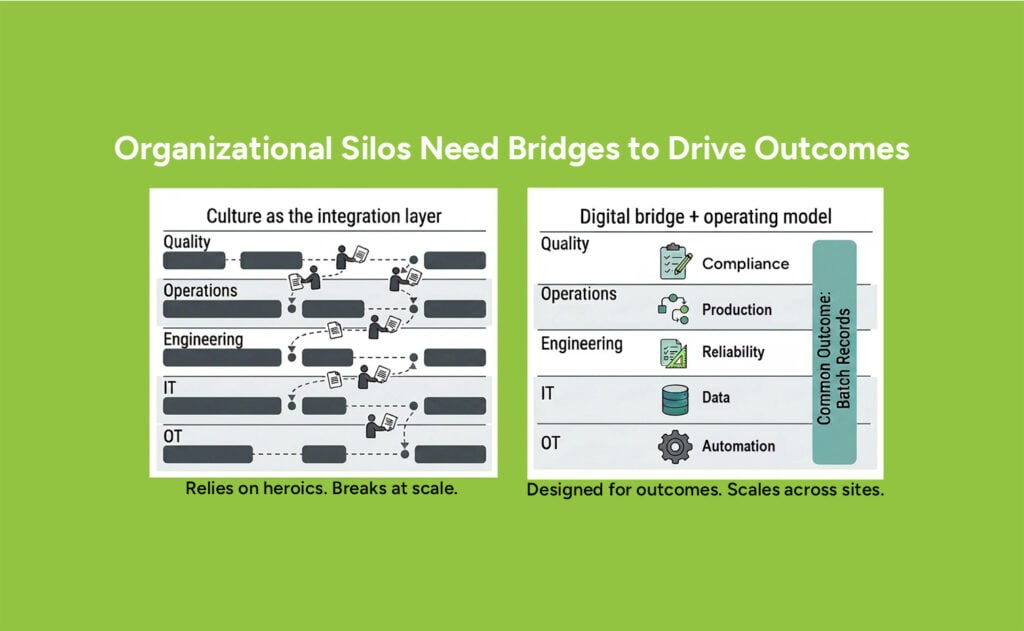
When digital technology does not intentionally bridge these gaps, organizations end up using culture as the integration layer—relying on relationships, heroic collaboration, and “how we work around it here” to make end-to-end processes flow. Culture matters, but it does not scale reliably across sites, shifts, vendors, and time. What scales is an operating model and digital foundation designed for end-to-end outcomes. Bridging the gaps requires designing platforms and processes that connect people, processes, and technology around shared outcomes.
Strategy vs. execution: An obvious gap is between strategy and execution. An organization’s future state is typically designed by a global strategy team, who then hands off frameworks or programs to localized teams for execution. Both groups work toward the same goals, but they speak different languages and use different metrics to measure success. Strategy teams may exit the picture before their vision has been fully implemented and adopted—so they aren’t privy to considerations such as legacy systems, local culture, and resource capacity that slow or stall progress.
Quality, operations, and engineering: We frequently see this disconnect during capital projects for new manufacturing facilities. Capital teams deliver facilities and capabilities optimized for cost, schedule, and scope. Operations teams frequently enter the project too late to influence design decisions that define performance for years to come. Digital investments are particularly prone to being underoptimized, with bottlenecks discovered only after deployment, when they require costly rework and a delay in production schedules. The result is facilities that meet specifications on paper but are not built for how people work. Solutions that are technically sound fall short, and the result is predictable. The value of the investment—in new ways of working, new systems, new capabilities—fails to materialize.
IT vs. OT and disconnected data: Even within a single facility, silos persist. Quality, engineering, and operations work together to ensure safe, reliable production, yet their primary drivers and success metrics often create friction with one another. Engineering view quality as slowing progress; operations treats quality as necessary but secondary to output; and quality sees both functions as underestimating risk. Similar friction exists within IT and OT teams. IT optimizes for standardization, security, and cost efficiency. OT optimizes for uptime, production, safety, and compliance. OT systems—DCS, MES, historians, LIMS—evolve independently of enterprise IT and cloud platforms, producing data gaps and ambiguity about ownership. Some of this friction is healthy and beneficial. By design, priorities like speed and safety are in healthy conflict with one another. But unnecessary friction creates a drag on the entire system. No party is doing anything “wrong,” but everyone feels frustrated.
R&D → clinical → commercial tech transfer: Across the drug development pipeline itself, process knowledge, data models, and digital tools differ from R&D to clinical to commercial. Still, most teams lack a coherent digital tech transfer strategy to harmonize this data. Time adds another layer of complexity. The journey from early development to full‑scale manufacturing is a multi‑year relay where knowledge degrades at every handoff. Teams rotate. Institutional memory fades. Downstream teams expend effort reconstructing what upstream teams already knew instead of building on it.
If you want silos to stop dictating performance, the starting point cannot be a list of functional requirements gathered in isolation. A better starting point is to design for collective outcomes, then engineer the organization and the technology to deliver them.
Examples of outcomes that unify operations, quality, and technology:
At Stellix, we call this concept “the bridge.” Becoming the bridge means aligning the organization around measurable outcomes and closing the gaps where work predictably breaks down across functions and systems.
Those impacts can be significant:
Few organizations assign ownership across the bridges that are necessary to align their functions. Sometimes it is difficult to navigate this challenge from inside the organization, and an outside point of view may offer a valuable new perspective. Stellix often occupies that space, developing solutions that bring teams together to accelerate performance and deliver results.
We cannot work toward collective outcomes without enterprise-level visibility. And we cannot achieve visibility as long as processes remain on paper or automation, operations management, historians, and data platforms continue to produce siloed data. Connecting these systems is foundational work, but technology alone is insufficient. Successfully bridging silos requires addressing people and process with the same rigor we typically reserve for technology.
On the people side, we start by understanding how scientists, operators, engineers, and quality teams actually work, not how a process map says they should. Through direct engagement, persona development, and workflow analysis, we learn where the real friction exists and where new ways of working can take hold. Change management shifts from pushing adoption on reluctant employees to implementing solutions that demonstrably make people’s jobs faster, easier, and more enjoyable.
On the process side, we focus on designing adaptive operating models with clear decision rights, governance structures, KPIs, and feedback loops. Continuous change becomes part of daily operations rather than a sequence of disconnected projects. We integrate reliability programs, operator performance services, and capability building from the outset so that improvements endure beyond any single project.
Bridging silos leads to measurable impact across three critical dimensions.
Production becomes more reliable and predictable. Moving from reactive maintenance to predictive reliability reduces unplanned downtime and quality incidents. As data moves across functions, workflows become visible, decisions rest on real performance data, and yield stabilizes across campaigns. Capital projects and digital investments deliver assets aligned with how the workforce operates, so output meets expectations from day one.
The workforce becomes more engaged toward continuous improvement. Adoption of new technology and processes is smoother because their value is tangible and immediate. As people spend less time investigating deviations, managing workarounds, and navigating disconnected systems, their focus shifts to further accelerating performance.
The organization becomes more orchestrated and connected. With less friction between strategy and execution, organizational functions, and the technology and systems people use, change becomes easier. Teams can more quickly align on shared outcomes and use readily accessible data to make better, faster decisions.
Over time, these improvements support the ultimate outcome in life sciences: delivering life-saving therapies to patients with speed and consistency.
As continuous adaptation becomes the only sustainable operating model, Stellix provides the operational bridge to make it a reality in critical industries. Stellix bridges the gap between digital vision and real-world execution with operational foresight that helps to accelerate performance in new facilities and restore it in struggling ones.