Blog
The AI Journey at Stellix: Where We Have Been and Where We Are Going
Turning AI experimentation into governed, repeatable workflows

Turning AI experimentation into governed, repeatable workflows
Stellix is on a journey to becoming an AI-first organization. We operate in an environment that is familiar to many organizations: complex, regulated, cross-functional, and dependent on reliable execution. Challenges include fragmented systems, manual handoffs, knowledge concentrated in individuals, high expectations for quality and compliance, and the need to make decisions with incomplete or distributed information.
AI’s transformative potential for the company is clear, but we knew it would be a process to move from simple experimentation to realized business value. Over the last decade, we have built capabilities internally, grappled with the challenges that arise across people, process and technology, and applied our learnings about adoption, governance, context, workflow redesign, and measurement from the vantage point of operational experience rather than technical knowledge of AI tools.

Many organizations are currently struggling to define the clear path from AI investment to business value, relying on hope that activities will eventually lead to outcomes. Part of our commitment is sharing learnings back to the community on a regular basis. Events like our Aspire series are one way to facilitate shared learning; this article is another. In that spirit, here’s a snapshot of the Stellix AI strategy: what has been accomplished so far and where it is headed next.
We view AI as an operating strategy rather than a tool that delivers an ROI. AI allows users to work differently when data, workflows, systems, governance, and people are aligned, leading to better decision-making.
The Stellix AI strategy is organized around three practical opportunities:
Opportunities for AI in our business fall into one or more of these categories, and are further prioritized based on additional criteria: for example, if a problem occurs frequently enough in the business to make developing a new solution worthwhile. Workflows with measurable baselines already in place make it easier to quantify AI’s impact and opportunities for scale across teams, sites, and customer contexts. Financial constraints force prioritization and specificity about which problems we are solving, especially as many tools shift from subscription-based to consumption-based models. And all decisions must be made within the context of the appropriate governance and security considerations, with the IT department involved to ensure adherence to security and policy guidance.
Once an opportunity is identified, the next steps are to define the desired outcome and success criteria, run a small pilot, collect feedback, and assess table stakes functionality like cybersecurity, data privacy, and risks. When results indicate that a use case works, the learning can be converted into a reusable asset: an agent or skill, a workflow pattern, a data model, an implementation playbook, or an AI-readiness recommendation.
Because culture determines whether AI deployments are successful, we are developing a culture of questioning whether AI tools can help redesign how we work with each task in front of us. Experimentation is encouraged to first discover what is possible with the technology, and where there are risks, before defining and working toward an outcome. Learnings from these experiments are shared in various forums and formats across the team. As AI experimentation matures, it’s imperative to move beyond experimentation into driving outcomes for the business.
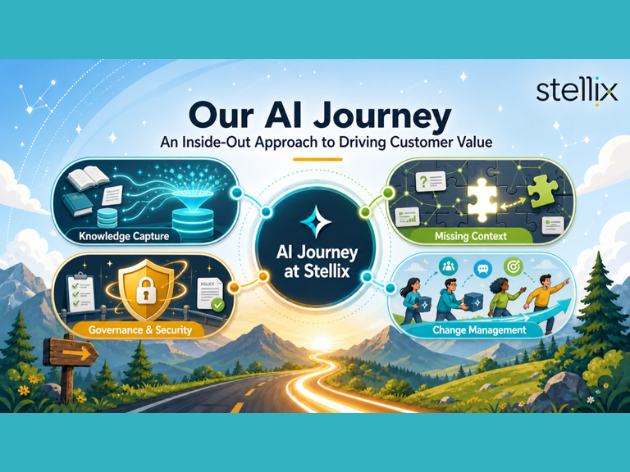
Application of our AI strategy has surfaced four factors that determine whether the AI tools are trusted and produce results. Two ensure the right knowledge is available for the challenge that AI is targeting: knowledge capture and context. The other two ensure people work to achieve the desired outcome: compliance and adoption.
In most organizations, much of the company’s knowledge is trapped inside the minds of its team members. Traditionally, knowledge transfer occurred through explicit training, mentor/mentee relationships, and informal, often spontaneous, conversations. These methods are imperfect but accepted. Two significant changes require rethinking this approach. First, hybrid and remote work environments reduce the number of natural collisions that spark conversation and collaboration. Second, new tools make knowledge capture and delivery easier and more comprehensive.
Common sources of knowledge include IT system data (e.g., ERP, CRM, ITSM, CMMS), workforce collaboration (e.g., Atlassian, Monday), document storage (e.g., Sharepoint, Google Docs, Veeva) and industry-focused websites. Newer sources of knowledge that can be leveraged by AI tools include meeting transcripts, images, videos and photographs.
Access to a broad range of easily available information is a good first step, but company documentation typically lacks the context required for an AI application to generate highly accurate outputs. Accuracy is the foundation for trust, and teams need to be able to trust AI to adopt it. Project artifacts and deliverables, for example, typically don’t provide the process or steps, much less the strategy, values, or decision-making, that went into creating them. In order for AI to act intelligently, it needs more than the final outputs of a decision. It needs everything that goes into the decision-making process to produce the final product.
We partnered with The Kendall Project, an AI-driven workforce consultancy, to close the gap between the knowledge we have and the knowledge we need to make decisions. Their framework offers a repeatable structure to add missing context and describe the journey instead of documenting the artifacts of the process. The Kendall Project’s experience shows that this framework can move AI’s results from the generic 60-70% accuracy to higher levels that make applications more effective for users.
Adherence to customer/partner terms and conditions and the security of the data our organization touches is critical. While we encourage individual experimentation with AI, we also implemented strong infrastructure to protect all data that our employees interact with. Stellix also pursued and recently obtained ISO-27001 certification, a recognition of our commitment to information security, cybersecurity, and privacy protection.
Our AI systems have robust controls to ensure team members only have access to the data and processes required in their roles. We also segment customer data and incorporate best practices such as source citations to verify AI outputs. Finally, we ensure AI systems fully comply with customer terms and conditions about data storage, such as hosting data on-premises vs. in the cloud.
An effective AI strategy starts and ends with adoption and consumption by the people deploying it. The biggest shift for our team has been moving from “Can I trust AI?” to “How can I apply AI in this scenario?” The classic bell curve of adoption applies, and many employees prefer to wait for proven approaches rather than run their own experiments. Segmentation is key for determining who to invest in and how much to invest, but change management is still required for the entire organization. This is an ongoing process that requires role-specific education, examples tied to real work, feedback loops, clear governance, and leaders who reinforce appropriate use.
Investments include AI literacy programs, lunch-and-learns, one-on-one onboarding, sharing concrete use cases, and guidance on policies and guardrails. Subscribing to a tool does not drive behavioral change, but pairing tool access with education, examples, and a clear connection to a business problem does.
Early measures of enterprise AI initiatives typically focus on adoption-related metrics: tools deployed, dollars spent, seats licensed, tokens burned. Earlier this year, Stellix had approximately 85% workforce adoption, more than 300 published agents, and more than 9,000 cumulative agent runs. These results are representative of our discovery phase, in which the approach was to launch as many pilots as possible.
However, adoption is not directly correlated to value. Eventually, organizations need to measure outcomes rather than investment. This is because at an employee level, providers are shifting their commercial models from monthly subscriptions to consumption models that require companies to pay for tokens proportional to the work that AI is doing.
As adoption increases, the simplest metric for measuring value is often time saved across workflows. Three recent examples from our team:
Hours saved can frequently be equated to financial savings, and with the right data and systems in place, other measures, such as speed of response, increased capacity, decreased error rate, and higher customer satisfaction, can all be tied, if indirectly, to AI initiatives. These results are enough to justify the cost of a monthly subscription but do not necessarily justify the costs of token-based billing. If you can spend $1,000 in tokens to eliminate 1 week of work, should you do it? Who gets to decide? This is an area where we are actively learning about token consumption and the risks associated with managing its costs.
At present, we have completed the fundamentals of our AI strategy and are moving into scale. We have established a governed enterprise knowledge and AI foundation, made tools available broadly, built and tested agents, and started the transition from individual productivity to reusable workflows and customer-ready capabilities.
While we will continue to experiment with new applications, the next maturity step is to focus on optimizing investment by eliminating overlap while ensuring the best use cases are repeatable, measurable, governed, and connected to business outcomes.
The impacts of our AI operating strategy extend beyond increased productivity and efficiency for team members. An AI-enabled team can fundamentally change how we engage with our customer base: lower costs to serve, faster speed of response, and the ability to scale shared knowledge across the organization rather than relying on individual team members with specialized skill sets.
We consistently ask our own team to share what works and what does not, so the organization learns faster. We are also committed to sharing our learnings. Stellix is ahead in some places and behind in others—a sentiment no doubt shared with many other leaders on their own journeys to AI adoption. From here, we will build on our successes, shore up our weaker areas, and continue pressing forward.