Blog
Slowly, Then All at Once: On the Path to AI Maturity
Why AI's business value depends on trust, governance, and the work of scaling beyond individual use


Why AI's business value depends on trust, governance, and the work of scaling beyond individual use
Organizations are being deluged with AI tools, but despite the flood of enablement, leaders are still struggling to deliver solutions that drive visible business value.
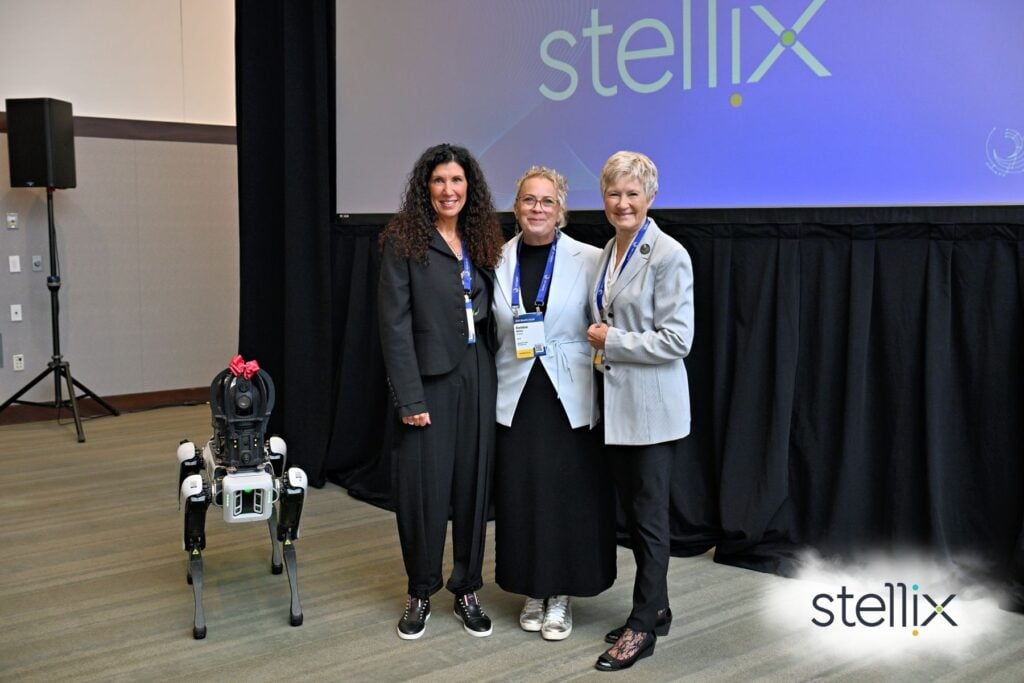
Stellix’s Aspire event series brings leaders across the life sciences industry together for shared learning. At our October event, I walked attendees through our internal Stellix AI journey shown in the image and had conversations about the challenges of AI enablement across a changing technological environment and differing adoption speeds.

Collectively, we are making progress, although it may be slower than expected. Companies are moving to new levels of AI maturity, although trust and lifecycle management remain big barriers between AI usage and business outcomes.
We think of our AI maturity within a three-tiered model: individual, shared, and enterprise value. As the adoption matures and moves to higher levels, we have a greater potential to realize value from AI investments.
Individual productivity and experimentation are where we learn what is possible and work within what we can control. When you’re given an AI tool, you can instantly see how it can improve what you do. AI-curious workers, including executives, play around, experiment, make cool things, and save personal time, all on a one-off basis. This level is about seeing what is possible. Individual use cases are easier because early adopters show what’s possible without much effort from the business, and they have no limits within the scope of their own team’s boundaries. Individuals do not have to align cross-functionally, and there are no business processes needed.
As value is proven and then shared with other groups, a level of software lifecycle management and continuous improvement needs to be added. How do we make the value realized by a single user available to others who did not develop the tool? How do the new users know the boundaries and constraints of the new tool and whether it is being maintained and accurate? Market insight and pricing & availability tools are some examples of where shared tools can add value. Shared tools need to incorporate shared knowledge like: when was it last updated, last used, last tested, which problem sets is it used for, and which problem sets has it not been used for. And all of this needs to be designed for human factors, which I will expand on in a later article. Shared value represents the shift from pilots to production, where they are the foundation for individual use cases that become consistently used and embedded in the company’s operations.
Real enterprise impact occurs when value is developed by a cross-functional group of stakeholders looking to achieve different outputs and have different success criteria. It starts with working in a cross-functional team to map workflow, inputs, and outputs across departments, and then redesigning how those people work. But then it requires a different level of coordination, lifecycle management, and continuous improvement after the tool is deployed for use. Each department needs to work differently within the redesigned process, but if one department does not work within the redesigned process, there is the potential that everyone will stop using the tool. Additionally, lifecycle management and continuous improvement need to be centralized in a center of excellence that manages needs across the groups. Examples of where enterprise value could be unlocked are quote-to-cash, production scheduling support, and deviation & CAPA support.
My conversations at Aspire suggest that most organizations have had a hard time moving beyond the individual level. Once tools move to shared or enterprise, they either quickly become outdated due to the pace of technology or adoption fades as missing processes do not allow value to build. I’m reminded of Solow’s productivity paradox. In 1987, as the use of personal computers began to explode, economist Robert Solow wrote, “You can see the computer age everywhere but in the productivity statistics.”
Investments in new technology do not improve productivity until organizations add new processes and new roles & responsibilities that are missing. We have seen this paradox play out with electricity, personal computers, the internet, smartphones, and now AI. Change happens slowly, then all at once. Right now, it feels like we are moving slowly. But breakthroughs will come as we build processes that we never needed before this moment in time.
One of the biggest barriers to achieving our goals with AI is trust. Trust in the tools and trust in other groups that we have no control over. We start building trust by ensuring AI tools have sufficient context, appropriate governance, and lifecycle management. Even then, change is difficult. Building trust across departments, or companies, requires significant effort and investment. AI solutions need training, governance, establishment of new rules and processes, rethinking how we work, sustained change management, and a constant look out for what is missing.
My perspective is that organizations and individual leaders are largely in the same place. Few feel bullish about their AI progress at an enterprise level, as most recognize that the number of open questions is expanding: how to ensure trust and explainability across departments, how to capture critical knowledge from individuals who may not be willing to use digital tools, and how to build win-win value for everyone across the value stream.
Technology is changing so fast that it’s not a matter of being ahead or behind everyone else; it’s about being agile and adaptable in response to a fast-changing environment.