Blog
What It Takes to Move AI Initiatives Forward
Why alignment on strategy, value, ownership, and risk is essential to moving from AI pilots to production

Why alignment on strategy, value, ownership, and risk is essential to moving from AI pilots to production
AI does not have an interest problem.
In life sciences manufacturing, most organizations can already see the potential: better decision support, more connected operations, smarter workflows, and eventually more autonomous ways of working. What many still struggle with is turning that potential into something operational.
At our June Aspire event, the recurring theme was not a lack of ideas. It was alignment.
Teams often agree that AI matters. What they do not always agree on is where to begin, how to measure value, which risks are acceptable, who should own the decision, and what deserves resources ahead of other priorities. In regulated environments, that lack of alignment is often what keeps promising initiatives from moving from pilots into production.
This is the challenge Stellix is focused on helping organizations solve: translating AI ambition into operating capability by connecting business priorities, operational realities, data foundations, governance, and execution.
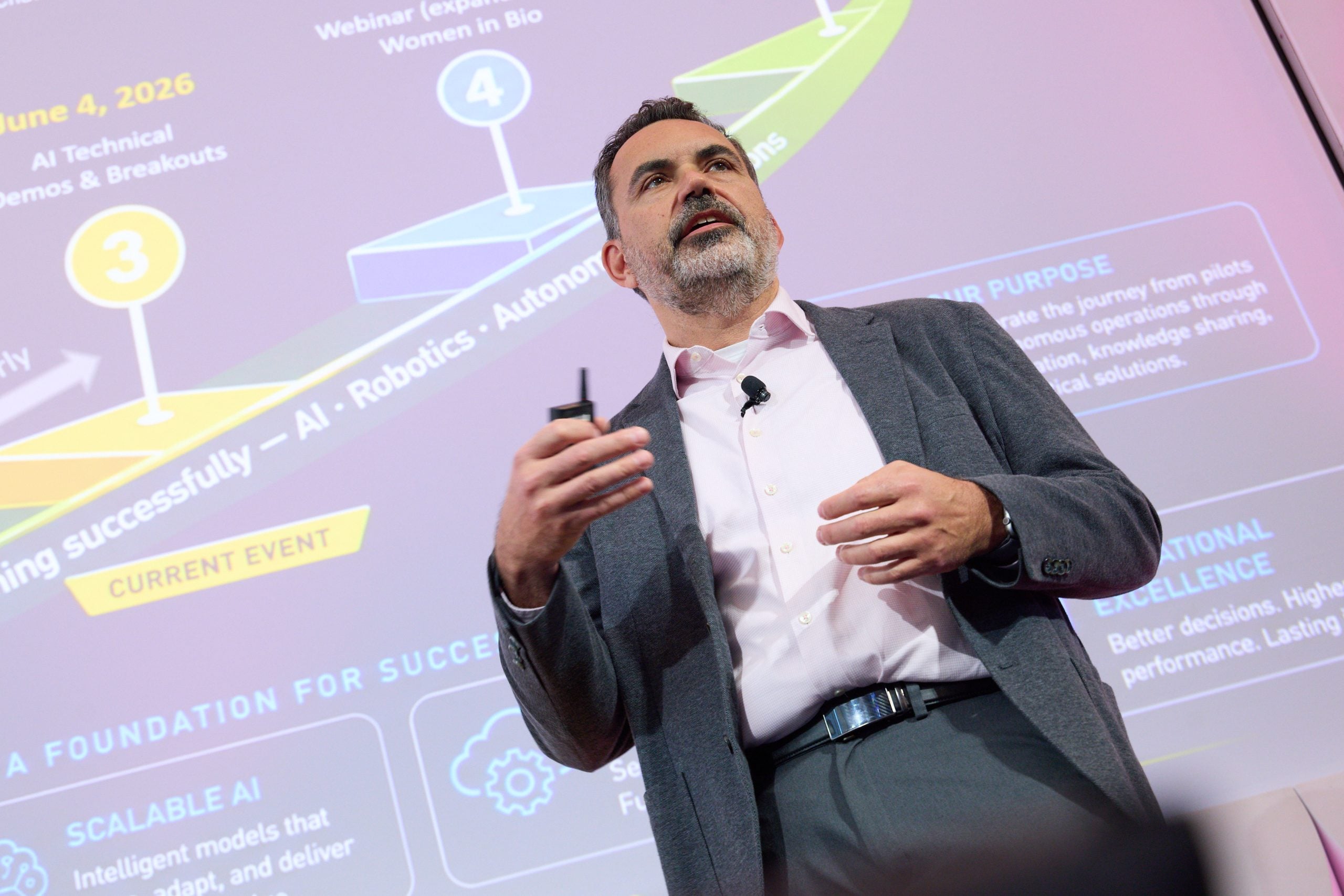
Jenn Azar opened the Aspire event with Stellix’s mission and vision and why AI has the potential to change how we operate. I framed the path from pilots to production and the digital foundation required for autonomous operations (our common North Star). We must look beyond technology to consider how we operate: how the role of people may change as our businesses become more intelligent, and how connected infrastructure, data, knowledge, governance, and AI-enabled reasoning work together.
Autonomous operations is a concept and direction, not a technology implementation. It requires an environment in which systems can observe what is happening, understand the operational context, reason across available information, and recommend or execute the appropriate response. We presented a mental model that connects dedicated systems, real-time event flow, knowledge and semantics, situational awareness, and AI-driven reasoning to a defined operational outcome.

Across the Aspire event the same theme surfaced repeatedly: AI initiatives are often slowed less by imagination than by differing perspectives on risk.
AI is different from other technology investments. Where teams often disagree about which initiatives are most important to the business, there is broad interest in prioritizing AI initiatives. The problem is risk. Each team, and each individual, brings its own perspective on and willingness to tolerate risk.
Executives are accountable for strategic priorities and resource allocation. Operations teams understand the friction embedded in daily work. Technology leaders see infrastructure dependencies. Quality and compliance leaders must consider patient safety and regulatory exposure. Finance teams weigh investments against others competing for the same resources. There is not one correct frame for evaluating risk in AI initiatives. Every point of view is legitimate, but without alignment across groups and transparency, these fragmented perspectives can stall progress.
AI initiatives have the potential for failure, and although failure is part of learning, we should take intentional steps to make decisions less risky for stakeholders. Openly sharing learning with our community is an important step in advancement. Events like Aspire are one way to accomplish this.
In a previous article on operationalizing transformation pilots, I argued that success criteria—how the organization defines what is important and how it is measured—are ultimately a leadership and values decision. Two organizations can pursue the same long-term vision while measuring progress in completely different ways. What Aspire emphasized was a practical consequence of that idea: that alignment is more than agreeing on priorities. Alignment is also about agreeing on what pathway, what journey we take.
Conversations during the event uncovered several factors that help teams create stronger alignment. These factors should be considered when designing and evaluating initiatives:
1. Clear connection to corporate strategy
A use case has a much greater chance of advancing when people can see how it contributes to an existing enterprise priority. We observed that top-down initiatives driven by leadership typically advance more easily, as they are often already aligned with corporate strategy and have executive support. Bottom-up initiatives, such as those that originate from operations teams, may have an indirect or less immediate link to corporate strategy, but to succeed, that link should be as explicit as possible. An initiative framed as an isolated digital experiment will almost always struggle against investments tied directly to growth, quality, capacity, resilience, or cost—frequently due to a lack of understanding of the risk and impact.
2. Shared definition of value
Organizations often look first for hard savings: reduced labor, lower vendor costs, increased throughput, less waste, or fewer unplanned disruptions. Those measures matter, but they are not the only forms of value. An initiative may also involve soft benefits such as improving decision speed, increasing operational transparency, reducing compliance risk, strengthening workforce continuity, making work more meaningful, or creating the foundation for future capabilities.
Any “bottoms-up” initiative that does not originate with corporate leadership must demonstrate hard savings. In multiple conversations during Aspire, we heard about initiatives with soft benefits that leadership ultimately shelved. To the extent possible, soft benefits should be quantified as well: defined, measured benefits will gain more traction with stakeholders and give an initiative a greater chance of success.
3. Cross-functional ownership
Transformation initiatives frequently fail when one group defines the opportunity, then asks the rest of the organization to support it. The people who own the process, fund the investment, manage the technology, govern risk, validate the solution, and use the resulting capability all need to participate early enough to feel like they own the decision.
That does not mean each stakeholder must agree on every detail. However, the organization must have adequate buy-in across stakeholder groups. That buy-in includes an understanding of the tradeoffs throughout the decision-making process and the risk involved, which all parties must be willing to accept.
4. Executive sponsorship
Transformation efforts compete with operational demands. Budgets tighten. Leaders turn over. New priorities emerge. Technical challenges become visible. Early results may be less dramatic than expected. An initiative needs sponsorship that is strong enough to protect the work through moments of change and transition. A technically sound use case without leadership sponsorship and long term continuity may remain an interesting pilot. A strategically aligned use case with clear value, cross-functional ownership, and sustained leadership support has a much better chance of becoming an operating capability.
One of the strongest aspects of the Aspire discussions was the focus on actual use cases, which gave participants the opportunity to examine the implications from different perspectives.
AI is easier to discuss when it remains abstract, but the conversation is far less useful. A real use case forces important questions:
Use case examples expose dependencies that broad technology conversations often hide and create a better basis for collaboration. People can compare how different organizations are approaching similar problems, identify recurring barriers, and distinguish between technology limitations and operating-model limitations.
Included demonstrations that grounded the concepts they presented in practical scenarios. A breakout session on single pane of glass, for example, highlighted that the industry lacks a shared vocabulary to even define single pane of glass as a concept. That ambiguity makes its way into organizations and increases the difficulty of building alignment. Several participants told me the session helped them understand what had been difficult to grasp in the abstract.
That feedback validates what I have long believed: innovative possibilities are fueled by vision and aspiration, informed and navigated through direct experience.
I left Aspire more convinced that the industry needs regular forums for working through its collective questions together. Difficult transformation issues are not resolved through one presentation, one panel, or one afternoon. They require continuity.
The life sciences community needs opportunities to return to the same problems, bring back what it has learned, challenge earlier assumptions, and determine whether ideas that sounded promising worked in practice.
That is what I hope Aspire becomes: an ongoing forum where operators, technologists, executives, quality leaders, partners, and practitioners can examine real challenges together. A place where people can discuss not only what is working, but also what is stalled, underfunded, misaligned, or still considered too risky. Where demonstrations make new capabilities tangible, teams can compare use cases across organizations, and networking happens through substantive discussion.
We will continue the conversation through upcoming Aspire events during Boston AI Week in September and in October, in partnership with Women Applying AI. Please reach out if you are interested in joining us. We will not realize the promise of AI by learning in isolation. We have to build with shared experience.