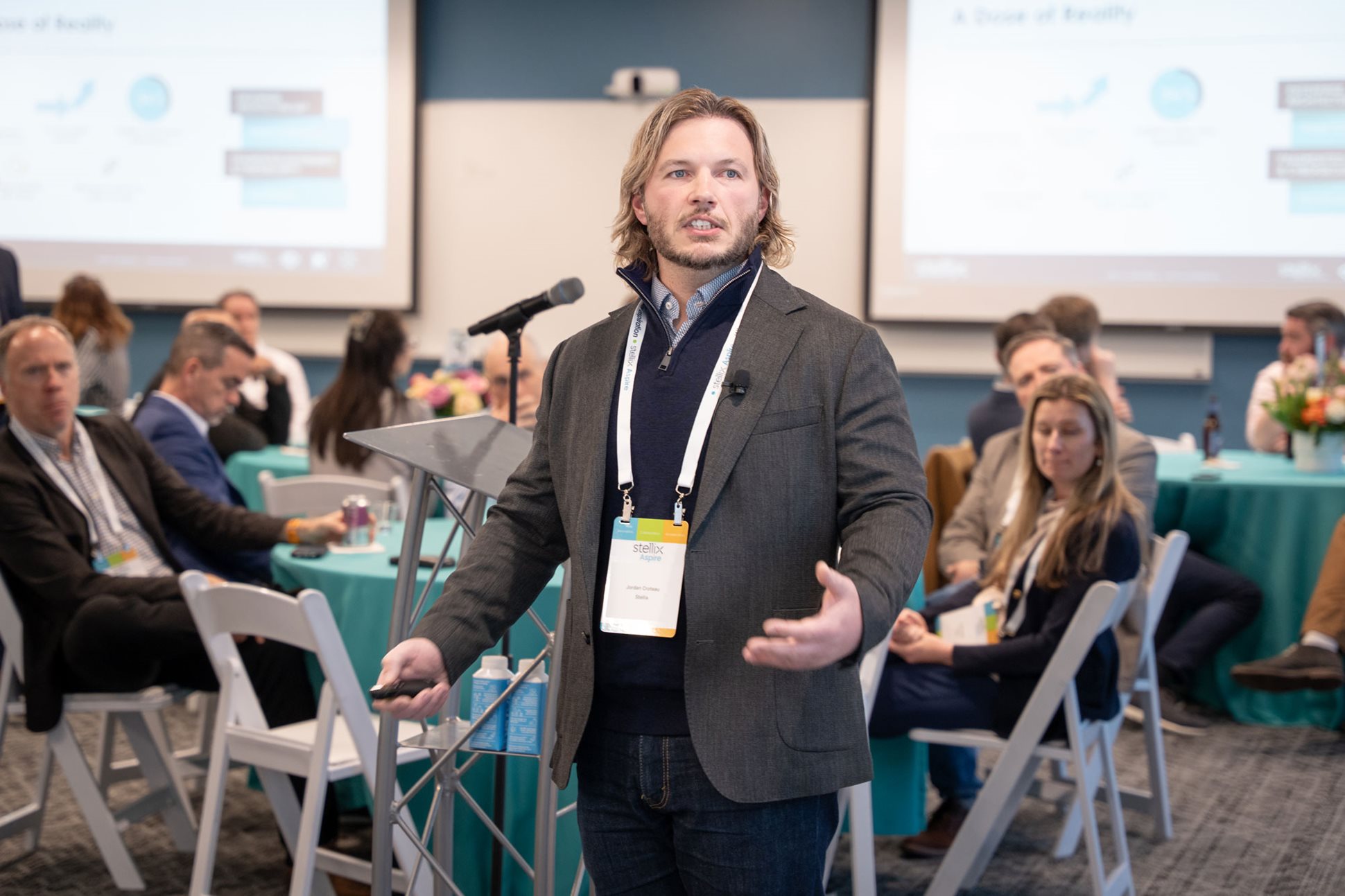
At Stellix’s first Aspire gathering of 2026, I closed the day with a session on what the Tech Ops of the future looks like and where our ambitions are not meeting reality.
I come at this as a practitioner first. Before joining Stellix, I served multiple roles within Moderna, first as Head of Digital for Manufacturing and Facilities, and then took a broader view as Head of CMC Architecture and Innovation, after years working as a solution and enterprise architect in multiple life sciences companies.
From that vantage point, I’ve seen both sides of the AI story in life sciences: the inspiring vision and the humbling reality.
In this post, I’ll recap three themes from my Aspire session:
- The gap between bold vision and operational reality
- The journey from human-in-the-loop to human-on-the-loop
- Why you don’t need to start over — you need a vision, then start small and keep building towards it
1. Our bold vision — and the humbling reality check
In Tech Ops, we have a very bold vision.
A fully connected value chain, from development through to delivery.
- Lights-out manufacturing and dark factories
- Digital twins of our operations driving intelligent automation
- One-click tech transfer
- A workforce of the future — not replaced by AI, but augmented by it
- Ubiquitous knowledge available to every scientist, engineer, and operator
We invest heavily in new tools and technologies to accelerate that future. We talk about the lab of the future and the factory of the future — robotics, AI assistants, end-to-end automation, zero defects, and lights-out plants.
But reality must set in.
I described in the session what is “a disparity between our aspirations and reality.” We aren’t getting the value we are expecting. We have:
- Lots of POCs
- Lots of point solutions
- But very little that actually scales across the enterprise
We are all also learning that our AI “is actually not that intelligent.” If you’ve interacted with a chatbot that gives you a beautifully worded, confident answer that turns out to be wrong, you’ve seen the problem. It’s like that person in a meeting who sounds brilliant but, on inspection, hasn’t really said anything.
The core issues?
- Missing context
- Lack of real-time information
- No semantic memory — the understanding of “how it all connects” that humans bring to their work
We tried to compensate with technology. We built what I still think was a very advanced knowledge graph for Manufacturing, using industry standards like ISA-95 as an ontology. Technically, it worked.
But when I moved into a broader CMC role and tried to port that knowledge graph into Quality and other areas, I hit a wall. The resistance was loud and clear:
- How does this apply to us?
- How are we going to govern this?
- What are the implications for our processes and controls?
Looking back, my mindset was wrong. It was technology first. I was so focused on what we could build that I underweighted governance, culture, and mindset shift. And my colleagues were right to push back: you cannot use AI safely or effectively in life sciences without those foundations.
That was the humbling reality check. But it also clarified the path forward.
2. From human-in-the-loop to human-on-the-loop
At Aspire, I introduced a framing that resonated with a lot of leaders in the room: the journey from human-in-the-loop to human-on-the-loop.
In Tech Ops, that’s fundamentally a transition of ownership:
- On the left side: “I don’t trust the AI to do anything.”
- On the right side: “I trust the AI to do everything.”
If you stay on the far left, you may feel safer — but you’re not gaining much efficiency. Every decision, every exception, every small action still routes through a human.
Moving toward human-on-the-loop doesn’t mean removing humans; it means changing their role:
- From performing every step
- To supervising, intervening by exception, and owning the outcome
To do that responsibly in regulated environments, we need a new kind of traceability. In life sciences, we already live with chain of custody and chain of identity. With AI, we need to add a third standard: chain of thought.
Chain of thought is how AI documents the steps it took along the way, so its decisions and actions are auditable and explainable.
Without that, you can’t defend your process to regulators — or, frankly, to your own Quality and Compliance teams.
A simple example: removing 80% of the prompts
One story from the session that brought this to life had nothing to do with large language models.
At a past company, a colleague discovered that our automation code had an insane number of prompts in it. Every couple of minutes, the system would stop and ask the operator to confirm or acknowledge something.
Those prompts weren’t adding value. They were just interrupting flow.
So, he removed roughly 80% of them. Suddenly, automation started doing what it was supposed to do:
- Moving smoothly through the process
- Eliminating unnecessary manual intervention
- Improving efficiency without compromising control
That’s a microcosm of the human-in-the-loop → human-on-the-loop shift. If you build in too many manual gates “just to be safe,” you never unlock the benefits.
Agentic workflows: smart alarming and zero‑click tech transfer
At Aspire, I also shared how agentic workflows make this shift real in tech ops:
- In smart alarming, an agent can:
- Detect an event
- Run impact assessments
- Log what was done and why
- Trigger downstream actions in MES, DCS, LIMS, and other systems
- Hand off to a quality review agent — with humans reviewing by exception
- In tech transfer, instead of a human lead pushing documents and recipes across functions, you can have:
- A “tech transfer lead” agent orchestrating the overall process
- Subordinate agents handling analytical, manufacturing, QC, and recipe work in parallel
- A readiness check agent validating completeness and consistency
- Human review only when something is flagged as an exception
We’ve talked for years about “one-click tech transfer.” In my Aspire talk, I suggested we should aim higher: “zero‑click tech transfer.” Not because humans disappear, but because:
- AI takes the lead on the routine, repeatable work
- Humans focus on judgment, escalation, and oversight
- And everything is built with chain of thought and compliance by design
That’s what human-on-the-loop really looks like in regulated operations.
3. You don’t need to start over — you need to start small and stay building
Here’s the good news I closed with at Aspire, and it’s worth underscoring:
You probably don’t need to rip and replace anything to get started.
In most life sciences organizations I work with today:
- The core digital systems (MES, LIMS, DCS, ERP, QMS, etc.) are already the right systems.
- Many of your vendors either have AI capabilities in the works or are actively piloting them.
- You’ve likely invested heavily in data platforms — data warehouses, data lakes, lakehouses, data hubs. If they’re working, they’re the right foundation.
The challenge is not “we don’t have the right tools.” The challenge is:
- How do we connect them coherently?
- How do we govern them responsibly?
- How do we avoid more POCs and point solutions that don’t scale?
This is where I tell leaders they need three things.
a. Adaptive guidance — a GPS for your AI strategy
You wouldn’t drive an unfamiliar route in a foreign country without navigation. The same is true for AI in tech ops.
You need adaptive guidance — a kind of GPS for your AI strategy:
- People and partners who have done this before
- Industry standards and ontologies you can build on, not reinvent
- A roadmap that adapts as you learn, but keeps you pointed at the destination
At Stellix, that’s exactly the role we aim to play: helping you turn episodic experiments into semantic understanding across your value chain, so AI is grounded in the way your business actually works.
b. Discipline: don’t shelve, keep shaping
Most AI initiatives in our industry don’t fail because the technology doesn’t work. They stall:
- When AI is treated as a project, not a strategy
- When early pilots don’t immediately produce outsized ROI
- When no one clearly owns the operational outcome
My message at Aspire was simple: you can’t just start, get disappointed, and shelve it. You need to:
- Stay the course
- Adjust scope and design as you learn
- Keep tying AI back to real operational problems — deviation handling, throughput, tech transfer timelines, quality review time, and so on
c. A connected, scalable foundation — not more silos
Finally, you need to avoid repeating the pattern that burned so many of us in the first wave: isolated point solutions.
By all means, start small:
- Begin with augmented use cases
- Keep humans in the loop early
- Prove value in a focused area (e.g., smart alarming, batch record review, tech transfer support)
But design from day one for:
- Reusability of data and knowledge (e.g., knowledge graphs, standard ontologies)
- Agentic workflows that can be extended to new use cases
- A single source of truth for operations, not four different versions split across manufacturing, quality, development, and supply chain
That’s how you gradually move toward human-on-the-loop autonomy without ever compromising on compliance, traceability, or patient safety.
Where Stellix fits in
If there’s one lesson I carry from my time at Moderna into my work at Stellix, it’s this:
Technology is necessary, but never sufficient.
You need governance, culture, and mindset evolving alongside the stack. You need Operations, Quality, and Digital at the same table. And you need a partner who has lived both the quixotic vision and the gritty reality of building AI-enabled operations in regulated environments.
That’s the ethos behind our work at Stellix: operational foresight and AI-driven solutions, grounded in real-world constraints, not slideware.
If you’re wrestling with these questions — how to close the gap between your AI vision and your current reality, how to move from human-in-the-loop to human-on-the-loop, or how to build on the systems you already have without starting over — I’d welcome the chance to continue the conversation.
Reach out to the Stellix team and let’s explore what building the tech ops of the future looks like in your organization.
Jordan Croteau is Head of Intelligent Operations at Stellix and former Head of CMC Architecture and Innovation at Moderna.