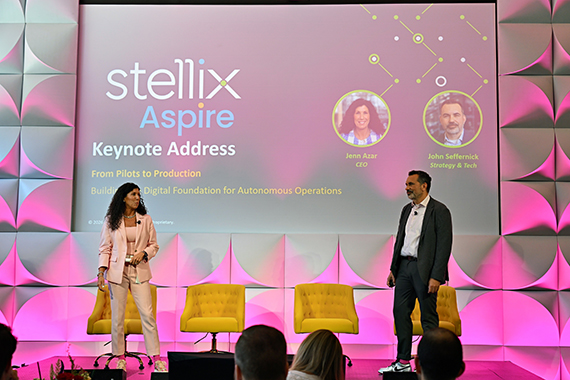
When Stellix set out to plan the latest event in our Aspire series exploring the future of AI in life sciences, the consensus was clear: Let’s get practical. Let’s get into the technical weeds. Previous events focused on big-picture thinking about innovation and AI readiness. This time, we wanted to roll up our sleeves, get hands-on, and move from idea to execution.
We built an agenda around showing what’s possible with AI, live and in real time. We ran a rapid-fire series of technical demos: four use cases illustrating AI’s operational impact, each followed by candid group discussions.
Shaun Setlock and Jordan Croteau lit up the room with a demo of an event-driven nervous system for digital operations at scale. Chris Puzzo and Mike Cody showed us how to turn fragmented processes into crystal-clear batch visibility. Matt Daniels and Jordan Croteau got into the nitty-gritty of applying agentic AI to real manufacturing challenges. Tim Adkins and Sachin Suryawanshi explored how to lay the foundation for faster, more reliable scale-up.
An interesting takeaway emerged during the group discussions. Attendees—many of whom work in technology-focused roles—said that while they’re ready to move forward with digital solutions, their organizations aren’t yet ready to adopt them. At the executive level, leaders are still grappling with the big, thorny AI readiness questions. If you’re seeking to push AI from pilots to production in life sciences or another complex industry, you may have hit the same wall.
People across the organization must be prepared to embrace a new way of working–more agile, fast-moving, and dynamic than what they are accustomed to. That begins with leadership making a clear and confident case for embracing AI–what business problems are we solving for and then aligning the entire organization around shared objectives. Every ops playbook I’ve seen mirrors the advice we’ve learned firsthand at Stellix: organizations need cross-functional, blended teams comprising people at all levels to get the outcomes they want from AI. Leadership needs to understand what is possible from technical experts who understand the practical realities of AI tools, and in those same conversations, technical experts need to better understand the business objectives around which to build AI initiatives.
I don’t have all the answers, but I know we can achieve far more together than we can alone. My colleague John Seffernick nailed it when he pointed out that if every individual company is vetting 500 industrial AI technologies, that's a great deal of wasted effort. The alternative is much more appealing: joining forces across the life sciences ecosystem to take on the work of learning and exploring what’s ahead together.
Stellix will continue facilitating this collaboration through future Aspire events. And we’ll continue to tackle the future of AI in life sciences from different vantage points, exploring practical solutions while also preparing leaders for the tough work of organizational change.
We built an agenda around showing what’s possible with AI, live and in real time. We ran a rapid-fire series of technical demos: four use cases illustrating AI’s operational impact, each followed by candid group discussions.
Shaun Setlock and Jordan Croteau lit up the room with a demo of an event-driven nervous system for digital operations at scale. Chris Puzzo and Mike Cody showed us how to turn fragmented processes into crystal-clear batch visibility. Matt Daniels and Jordan Croteau got into the nitty-gritty of applying agentic AI to real manufacturing challenges. Tim Adkins and Sachin Suryawanshi explored how to lay the foundation for faster, more reliable scale-up.
An interesting takeaway emerged during the group discussions. Attendees—many of whom work in technology-focused roles—said that while they’re ready to move forward with digital solutions, their organizations aren’t yet ready to adopt them. At the executive level, leaders are still grappling with the big, thorny AI readiness questions. If you’re seeking to push AI from pilots to production in life sciences or another complex industry, you may have hit the same wall.
Is Your Organization AI Ready?
For an organization to move AI from idea to execution, from pilot to production, its digital foundation has to be rock-solid. The technology itself only makes up part of that foundation. You can’t bolt AI onto existing workflows and expect returns. You have to rethink processes, behaviors, and systems throughout the organization. And you have to get your data in order so that AI systems can produce viable outputs.People across the organization must be prepared to embrace a new way of working–more agile, fast-moving, and dynamic than what they are accustomed to. That begins with leadership making a clear and confident case for embracing AI–what business problems are we solving for and then aligning the entire organization around shared objectives. Every ops playbook I’ve seen mirrors the advice we’ve learned firsthand at Stellix: organizations need cross-functional, blended teams comprising people at all levels to get the outcomes they want from AI. Leadership needs to understand what is possible from technical experts who understand the practical realities of AI tools, and in those same conversations, technical experts need to better understand the business objectives around which to build AI initiatives.
Unlocking AI’s Potential Together
There’s so much opportunity ahead. Everyone feels it, everyone wants in. The desire is there, as is the momentum, but still, so much remains uncertain. What does it look like to align an entire organization around digital transformation? Where do you start? Questions like these persist across life sciences. We’re all in the same boat, facing a future filled with infinite possibilities and no “ONE” roadmap for achieving them.I don’t have all the answers, but I know we can achieve far more together than we can alone. My colleague John Seffernick nailed it when he pointed out that if every individual company is vetting 500 industrial AI technologies, that's a great deal of wasted effort. The alternative is much more appealing: joining forces across the life sciences ecosystem to take on the work of learning and exploring what’s ahead together.
Stellix will continue facilitating this collaboration through future Aspire events. And we’ll continue to tackle the future of AI in life sciences from different vantage points, exploring practical solutions while also preparing leaders for the tough work of organizational change.